

The minute our presence improved, customers started coming to us already referencing the blogs in the conversation. They were reading them, finding them valuable, and treating them with real authority.
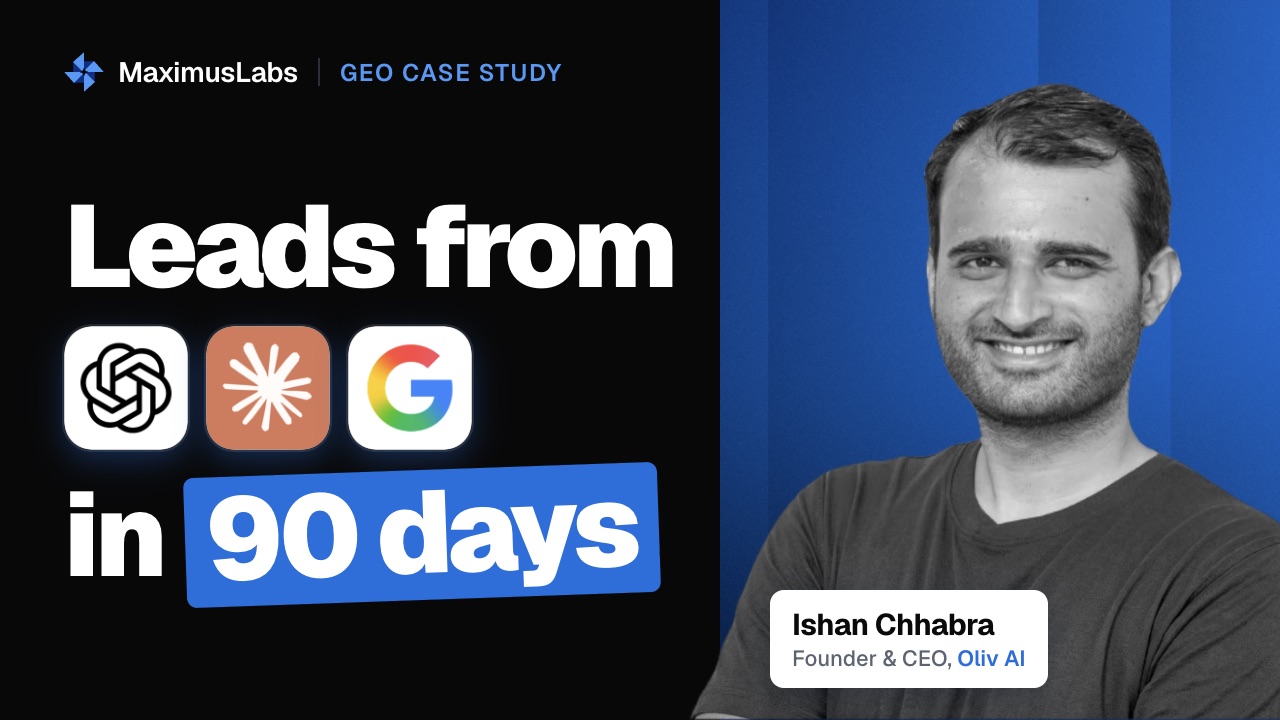
 Ishan ChhabraFounder & CEO, Oliv AIHear him say it · 02:34
It started as a small experiment. A warm intro, two calls, a lot of brainstorming, and one simple deal: three months to prove this could work. What follows is exactly what happened next, in Ishan's words and in Oliv AI's own dashboards.
The 30-second version
Start as an experiment. Become a pipeline channel.
Oliv AI gave us three months to prove that generative engine optimization (GEO) could move real revenue, not vanity traffic. That was the 90-day goal. The first inbound qualified leads landed within weeks, and today the program has produced $47K+ in pipeline from 27 leads, with a 26% close rate.
Win high-intent buyers against billion-dollar incumbents who invented sales-tech SEO, with a fraction of their resources and zero existing authority.
Bottom-of-funnel content, engineered so AI engines retrieve and cite it, written from the founder's interviews. End to end, strategy to maintenance.
$47K+ pipeline from 27 leads, with a 26% close rate. And oliv.ai became the #2 most-cited domain in its category, ahead of gong.io and salesforce.com.
The challenge
Going up against the companies that invented SEO
Given that it is a very crowded space, and the biggest competitors already have a massive SEO presence, it felt like an insurmountable challenge.
Ishan ChhabraFounder & CEO, Oliv AIHear him say it · 00:21How the decision actually unfolded, one step at a time.
- 1The situation
The hardest category online
Billion-dollar incumbents wrote the sales-tech SEO playbook. A decade head start, and a well-funded page on every keyword.
- 2The frustration
A great product nobody could find
Oliv AI had a sharp point of view and almost no organic footprint. Most founders see that wall and quietly give up on search.
- 3The risk
Invisible for 70% of the journey
G2 and 6sense: 70% of the buyer journey is over before they reach your site. Do nothing, and it all happens without you.
- 4The decision
Run the experiment anyway
So Oliv AI gave us three months: a 90-day goal to prove GEO moves real revenue, not vanity traffic, or walk away.
Not found, not shortlisted. Buyers ask AI comparison questions now: alternatives to the market leader, or an all-in-one revenue tool to consolidate their stack. AI rewrites each question into several searches and pulls the pages that match. That is rung 2, Retrieve, of the MaximusLabs Answer Ladder: "AI doesn't find us." A brand without those pages is not in the answer.
The proof
Pipeline first. Then the signals that led to it.
We report revenue first. Oliv AI's program produced $47K+ in pipeline from 27 leads, with a 26% close rate. The curve below is Oliv AI's own Google Search Console: a leading indicator that shows the climb, not the result.
The organic growth curve
Google Search Console, oliv.ai, February 2025 to March 2026. A leading indicator, not the result.
- Jun '25 · engagement begins
- Feb '26 · Google update
- $47K+Pipeline
- 27Leads
- 26%Close rate
- #2Most-cited domain in its category
The approach
Articles are not written for humans anymore. They are data sources for AI.
Classic SEO agencies still write for clicks and impressions; AI engines read pages as passages. The moment we built for that, everything about how we made content changed.
An article today is rarely read end to end by a human. It is read by a machine, parsed, and turned into an answer. So the job is not the prettiest blog. It is to be the most trustworthy, most exhaustive source on a topic, the one the model cannot leave out. We made Oliv AI a source AI cites and a brand it recommends.
It is not about hacking the algorithm. It is about building real authority in your space. Do that, and AI keeps coming back to you, whatever algorithm updates come.
 Krishna Kaanth MFounder and CEO, MaximusLabs AI
One article, engineered for every engine
A buyer's research is scattered across a dozen surfaces. We do not pick one. Every Oliv AI article is built to be retrieved and cited across all of them at the same time.
 Google Search
- Google AI Mode
- Google AI Overviews
 Perplexity
 Claude
 Gemini
 ChatGPT
The strategy
Revenue over vanity. Bottom of the funnel, first.
From day one we took a position: we would never optimize for clicks that do not convert. No top-of-funnel fluff. No impression-chasing. We went straight for the buyers closest to a purchase decision, the people already comparing tools.
If a person is searching for a competitor, they are a relevant buyer to us. That was the entire logic. So we attacked the bottom-of-funnel competitor keywords first, exhausted them, and only then moved up the funnel. Every piece had to earn a sales-qualified lead, not a vanity metric.
We went straight at the incumbents
A funnel, not a spray. We started at the sharpest, highest-intent keywords, then widened outward, one layer at a time.
- 1 · Highest intent[Competitor] alternatives[Competitor] pricing[Competitor] reviews[Competitor] vs Oliv AI
Switchers in active evaluation. The closest buyers to a decision, so we started here.
- 2 · CategoryRevenue intelligenceRevenue orchestrationConversation intelligenceBest revenue AI tools
Owned only after the competitor terms were exhausted.
- 3 · AdjacentSales tech stackForecasting accuracyDeal inspectionPipeline hygiene
The broad layer, built last, on a foundation that already ranks.
How Oliv AI climbed the Answer Ladder
Every brand is stuck on a different rung, and each rung needs different work. Oliv AI started at rung 2, then climbed. Deep before broad: one topic first, to build authority on one thing, then wide.
- Rung 2 · Retrieve
Get found for the buying questions
"AI doesn't find us." Oliv AI had almost no organic footprint, so we built the bottom-of-funnel pages that match the searches AI runs: deep on revenue intelligence first, then across the category.
- Rung 3 · Rerank
Stay in the answer
"AI finds us, then drops us." Every page opens with an answer-first passage and carries the founder's point of view and data, so engines keep it when they cut pages down to passages.
- Rung 4 · Reinforce
Earn the corroboration
"AI uses our content but names our competitors." The work now is the third-party mentions AI checks before it names a brand, so Oliv AI moves from cited to recommended.
The execution
End to end. Strategy to maintenance, one team owns all of it.
No handoffs, no "here is your content, good luck." GEO strategists plan and decide; GEO engineers build. One team runs the whole channel, from the first keyword decision to the refresh that keeps a ranking alive.
- 1
Interview
GEO strategists interview Ishan and study sales calls for the questions buyers actually ask.
- 2
Plan
They pick the rung to work on and the few pages that bring most of the pipeline.
- 3
Write
In the founder's voice, from the interviews, so it sounds like Ishan wrote it.
- 4
Engineer
GEO engineers structure every page so engines can retrieve and cite it: schema, clean HTML, AI crawlers unblocked.
- 5
Track
Rankings and AI citations as leading indicators; leads and pipeline as the result.
- 6
Refresh
Pages refreshed before they go stale, and new clusters added as the category moves.
How every single article gets made
Our own technology holds the standard on every page: a brand knowledge base, quality checks against the client's rules, and reviews by senior strategists.
- Context
A brand knowledge base
- Ishan's point of view and product facts
- Weekly competitor and market tracking
- Every writer on the same positioning
- Checks
Quality checks against Oliv AI's rules
- Answer-first passages, dense with data
- Automated schema and ranking checks
- Refreshes before pages go stale
- Review
Senior strategists sign off
- Every page read through the ICP's eyes
- Rewritten until it meets the bar
- Strategy reviewed every two weeks
Maximus captured the differentiated point of view we had into the space. It did not feel like your run-of-the-mill "13 ways to do X" article. That depth of voice, that depth of authority, really came through, and our customers bring it up when they book a meeting with us.
Ishan ChhabraFounder & CEO, Oliv AIHear him say it · 03:46Month by month
What actually happened, start to today
No six-month "trust us, it is coming" runway. Here is the real sequence, from the 90-day goal to the pipeline.
- Week 1
Technical audit and the first article live in days
We ran a full technical SEO sprint, agreed the keyword list with Ishan, and had the first bottom-of-funnel article published within the first week. No long onboarding. Momentum from day one.
Week one, shipped- Technical SEO audit
- Keyword map agreed
- First bottom-of-funnel article live
- Within weeks · The turning point
The first qualified lead arrives
Within weeks, our articles started ranking and Oliv AI landed its first inbound qualified lead. This one event changed the entire dynamic of the partnership.
The turning point- Articles ranking
- First inbound qualified lead
- Month 2.5
Inbound becomes a real channel
With leads landing and customers quoting the blogs back in sales calls, the company decided to make inbound a major channel. The experiment was no longer an experiment.
The decisionExperiment → Core channelinbound promoted from experiment to a major company channel - Month 3 · The 90-day goal
Results on the board, straight into execution mode
The 90-day goal was to prove GEO could move real revenue. Within the first three months, the results were there, and we moved from proof of concept into a longer engagement.
After 90 days- Results inside three months
- A longer engagement
- September 2026 · Measured
The #2 most-cited domain in its category
On non-branded prompts in the 30 days to 11 September 2026, oliv.ai was the #2 most-cited domain in its category, ahead of gong.io and salesforce.com.
AI citations#2most-cited domain, ahead of gong.io and salesforce.com (Peec AI, 30 days to 11 Sep 2026) - Today
Pipeline, not traffic
A year into the partnership and still going strong. The program has produced $47K+ in pipeline from 27 leads, with a 26% close rate.
Pipeline$47K+pipeline from 27 leads, with a 26% close rate
AI visibility
Oliv AI became the #2 most-cited domain in its category
Rankings are only half the story. The other half is which sources AI engines cite when buyers ask about revenue tools. On non-branded prompts in the 30 days to 11 September 2026, oliv.ai was the #2 most-cited domain in its category, ahead of gong.io and salesforce.com.
Who AI cites in Oliv AI's category
Oliv AI is not an outlier. In all four measured B2B programs, the client's own site was the #1 or #2 most-cited source.
- #2Most-cited domain
- 30 daysTo 11 Sep 2026, ahead of gong.io and salesforce.com
- #1 or #2In all four measured B2B programs
When a buyer asks an AI which revenue tool to use, it names only a handful. Being a source it cites is how a brand gets into that handful.
Citations are a leading indicator, never the result. The result is the pipeline: $47K+ from 27 leads, with a 26% close rate.
The engine we are still working on, and we will tell you so
ChatGPT is the hardest engine for Oliv AI. It leans heavily on Reddit, Wikipedia and third-party mentions, which take longer to earn honestly. That is rung 4, Reinforce, of the Answer Ladder, and it is the work now.
The ROI
This is revenue, not traffic
MaximusLabs AI is a full-stack GEO agency for B2B SaaS and AI companies, and revenue is the only scorecard. We do not report impressions and call it a day. We report leads, sales-qualified leads and pipeline. Here is why this kind of growth converts.
- 27Leads
- 26%Close rate
- Pre-soldBuyer intent
The magic of inbound: we stopped chasing
With inbound, we chase no one. The buyer has a need, searches, finds Oliv AI, and arrives already convinced. It shows in the numbers: 27 leads, a 26% close rate. Remember the 70%: by the time they reach the site, most of the decision is made.
And they tell on themselves. In sales calls, they quote the blogs back. The selling is half done before the first call even starts.
When customers came to us, they referenced a lot of the content they had read on the blogs in the conversation itself. They are actually going and reading them, finding them valuable, and treating them with authority.
Ishan ChhabraFounder & CEO, Oliv AIHear him say it · 02:43In the founder's words
Why the partnership stood out
What stood out was the urgency. Most vendors say it takes six months to a year to build authority. Here there was a clear push to prove it fast, and within the first three months we started to see results. That led to a lot of momentum and a good base to grow together.
Ishan ChhabraFounder & CEO, Oliv AIHear him say it · 04:49Oliv AI trusted us early, and we do not take that lightly. So we set ourselves a challenge.
What's next
The northstar: make Oliv AI bigger than the incumbents
Oliv AI's pages now compete with billion-dollar incumbents in Claude, Perplexity and Google AI Mode, and ChatGPT is the next rung of work. A seed-funded company, in the hardest category there is, already ahead of gong.io and salesforce.com in AI citations.